
Exploiting Engine Weaknesses in Closed Positions
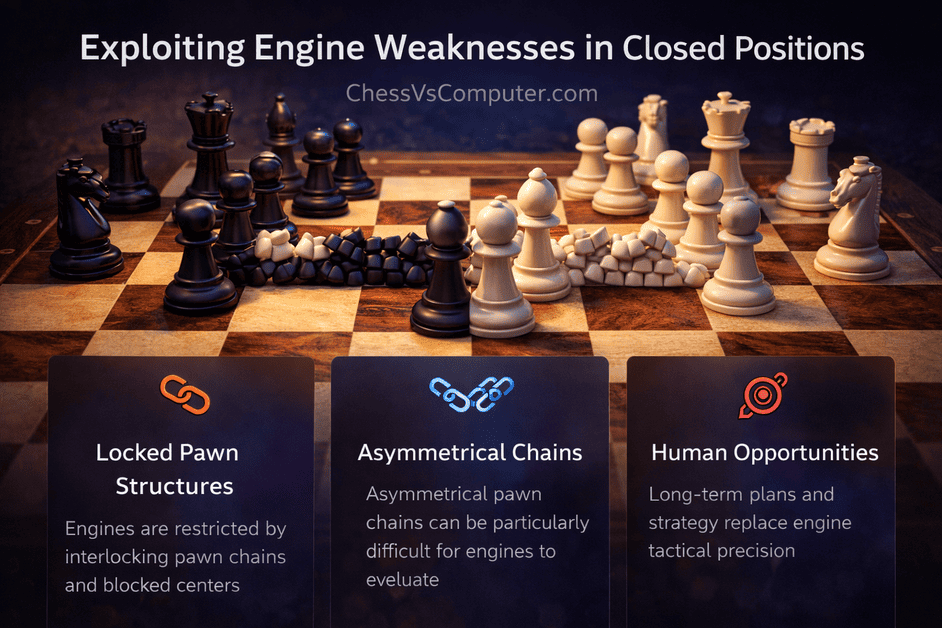
Computer engines dominate open positions where tactics reign supreme. However, closed positions with locked pawn chains remain a great equalizer. They create conditions where human strategic intuition can compete with silicon calculation.
In these positions, the "calculation horizon" matters less. When you play against the computer in a closed French Defense, the engine's evaluation advantage drops significantly compared to an open Sicilian.
Why Closed Positions Work
Closed positions feature fewer forcing moves. Instead of 20 candidate moves, there might be 3. The game shifts from tactical calculation (engine strength) to strategic planning (human strength). An engine might evaluate a position as +0.5, but if the plan requires a 30-move maneuver, a human can often defend successfully.
Effective Closed Position Features
The French Defense
The French Defense is the quintessential anti-engine opening. The locked center forces slow maneuvering. When practicing on ChessVsComputer.com, try setting up the Advance Variation and holding the center.
Practice Tip
Focus on executing long-term plans rather than searching for tactics. Patience is your best weapon here.
By steering games toward locked pawn structures, you neutralize the engine's greatest strength: tactical calculation.
Apply These Strategies Instantly
Don't just read about beating the engine—do it. Challenge Stockfish now on ChessVsComputer.
Play vs Computer