
Endgame Tablebases: What They Mean for Engine Play
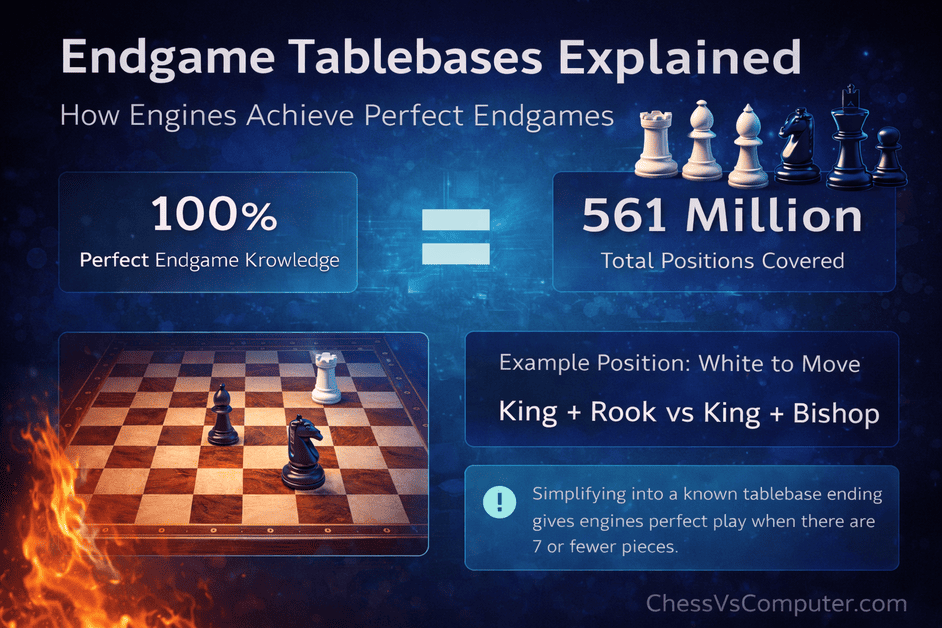
A hidden superpower of modern chess engines is the Endgame Tablebase. These are massive databases containing perfect play for all positions with 7 pieces or fewer.
Once a game reaches 7 pieces, the engine stops calculating. It simply looks up the answer. It knows instantly if a position is a win, loss, or draw, and the exact move to achieve it. This means "tricking" the engine in a simplified endgame is impossible.
Strategic Implications
The golden rule when you play chess online against bots: Do not simplify if you are worse.
❌ What NOT to Do
- • Trade pieces to "relieve pressure" when down material.
- • Enter King+Pawn endgames hoping the engine miscounts.
✅ What TO Do
- • Keep queens and rooks on the board to maintain complexity.
- • Only simplify if you know the resulting endgame is a theoretical draw.
Principle: Complexity Over Simplicity
Against tablebase-equipped engines, chaos is your friend. Complexity degrades their calculation advantage; simplicity makes them perfect.
Understanding tablebases teaches you to fight in the middlegame. Avoid the treacherous simplification trap where "defensible" positions become theoretically lost.
Apply These Strategies Instantly
Don't just read about beating the engine—do it. Challenge Stockfish now on ChessVsComputer.
Play vs Computer